You will never be pressured here
If hearing aids are the right answer for you and you want to move forward, we can do that. If they are not, we will tell you, and you will leave knowing exactly where your hearing stands either way.
We start by listening
Before any equipment comes out, we talk. Where you struggle, what you have already tried, which situations matter most to you, what your family has noticed that you may not have. A hearing test measures your ears. The conversation is what tells us what to do about them.
Then we look
We perform video otoscopy before testing, and the image goes on a screen you can see at the same time we do. Sometimes that is where the appointment ends. If wax is occluding the canal, or something suggests a middle ear or eustachian tube problem, hearing aids are not the answer. We work closely with an ENT practice down the hall who handles that well, and we will get you pointed in the right direction.
Then we test
A complete hearing evaluation in a sound-treated booth, performed at calibrated intensities. That calibration matters more than it sounds: it is what later tells us the exact sound pressure level each frequency needs to reach at your eardrum, which is what makes real verification possible at the fitting.
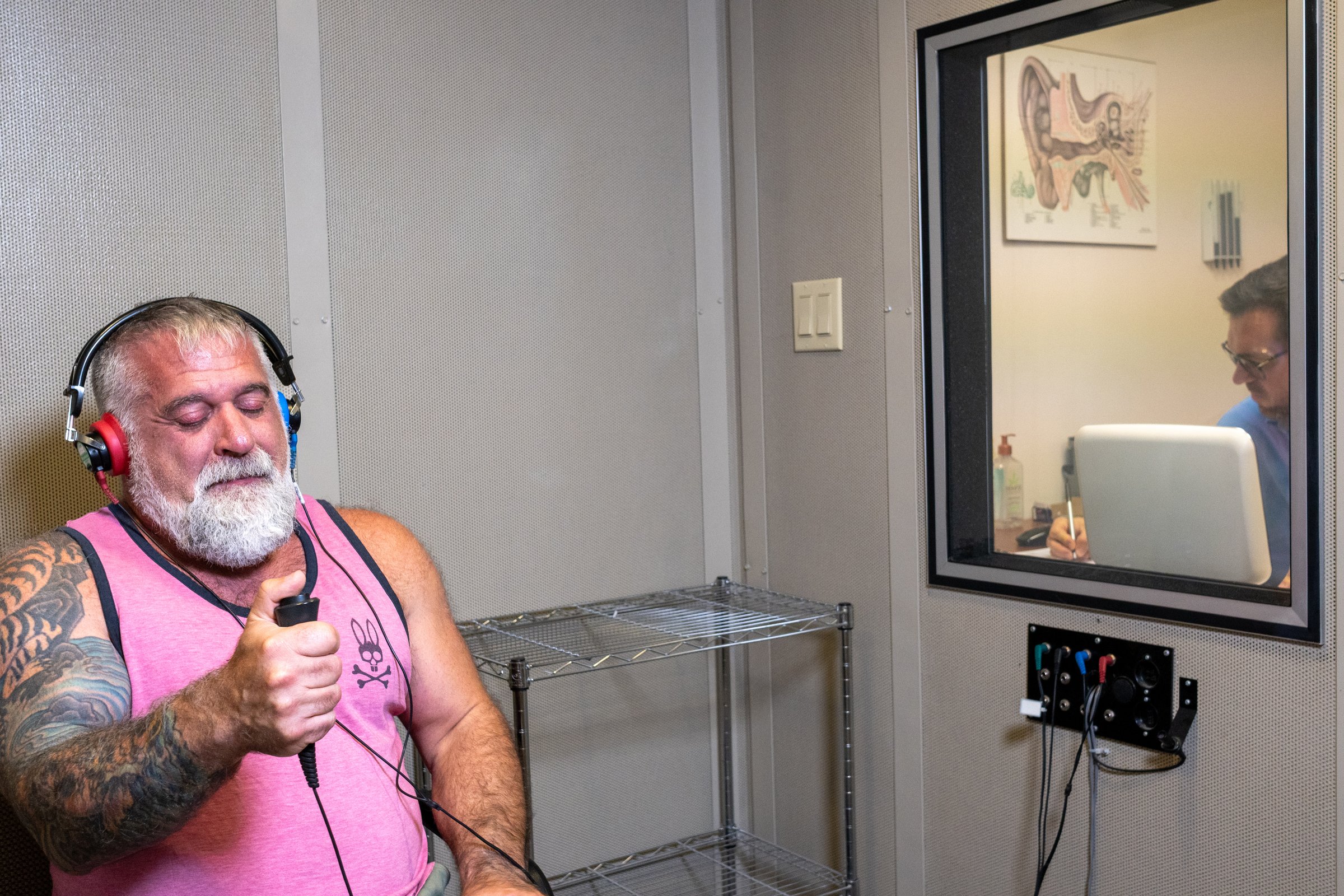
Then we explain
We go through your results with you thoroughly and in plain language. What the audiogram shows, what it means for speech, why certain sounds disappear before others, and what can and cannot be improved. If someone came with you, they hear all of it too.
Then, if it makes sense, we recommend
A recommendation built around your hearing loss, your ear anatomy, how you actually spend your time, your preferences, and your budget. Not around what we happen to have in stock.
And if you decide to move forward, everything that follows is covered. See what is included for the life of your hearing aids.
How long does it take?
Longer than you may be used to. We schedule real time for these appointments because the parts that get cut in a rushed schedule are exactly the parts that determine whether you end up hearing well.
What to bring
- Your completed intake form, if you were able to print it ahead of time
- Any hearing aids you currently own, even if they are old or you have stopped wearing them
- Your insurance card, if you believe you may have a hearing benefit
- A spouse, family member, or friend, if you would like a second set of ears
You see your own ear canal on screen before anything is recommended.
Performed in a sound-treated booth, which is what makes verification possible later.
In plain language, with your family in the room if you want them there.
If hearing aids are not the answer, we will tell you that.
Ready to find out where your hearing stands?
Call us, or send a request and we will follow up. Please leave medical details out of the form; we will cover those in person.
Request an Appointment